 Your browser is out of date. For best experience switch to latest updated Browser.
 Get Chrome
 Get Edge
 Get Firefox
Ability Levels
Categories
Resource Types
Age/Grade Range
CCSS
Anchor Standard
Speaking & Listening
Language
Reading
MAIS and MUSS checklist information
$ 0
Administration instructions for the Meaningful Auditory Integration Scale (MAIS) and the Meaningful Use of SpeECH- Scale (MUSS). These are parent report scales which allow the examiner to evaluate a c
...
hild's skills in meaningful, real-world situations.
Activities for Listenings and Learning - ALL (fillable)
$ 295
ALL - Performance Checklist for Development of Complex Listening Skills. Provides a list of Listening, Communication, and Learning Skills with spaces to complete progress. Areas: auditory association,
...
discrimination, memory, closure, humor, etc.
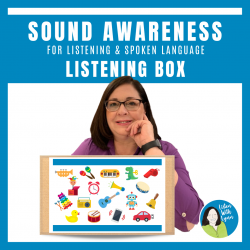
A Listening Box DIY For Sound Awareness
$ 3
A LISTENING BOX is a must-have tool if you guide families of young children who are deaf and hard of hearing. A Listening Box is fun and colorful. It holds sound-making toys, objects, and toy instrume
...
truments in order to present the sound through hearing first. The sound-making objects are hidden behind the Listening Box’s lid which little kids love. This Learning To Listen activity helps a child develop sound awareness and attach meaning to speech and environmental sounds. It is a classic Listening and Spoken Language Auditory Verbal activity for beginner listeners.DIY In one of my early intervention auditory verbal sessions with the parents or caregivers we make a DIY Listening Box together either face to face or in a teletherapy session. It gives us time to chat when I can offer important information about sound awareness and listening and spoken language outcomes.This resource includes:✧ Auditory targets for showing awareness of meaningful indoor and outdoor environmental sounds, music, and speech✧ Direction to make a Listening Box* with your own cardboard box with a lid✧ Colorful printable graphics for multiple-size boxes✧ 8 Tips for using a Listening Box✧ Recommendations of musical toys, noisemakers, and Learning to Listen Sound Association Objects to fill the box.*Box and toys not included.On the blog: DIY Listening Box◈ ◈ ◈ ◈ ◈ ◈ ◈ ◈ ◈ ◈ ◈ ◈ ◈ ◈ ◈ ◈ ◈ ◈ ◈ ◈ ◈ ◈ ◈ ◈ ◈ ◈ ◈ CUSTOMER TIPS:➼ Questions? Email me before purchasing this resource or anytime later.♥ Sign-up HERE for the Listen With Lynn Newsletter♥ Let’s Connect:InstagramFacebookKeep up your good work. I am blessed to help along the way. Thanks so much!Lynn
Listening Development Profile
$ 195
The Listening Development Profile allows the DHH specialist to rate aspects of student behavior as a beginning listener, intermediate listener, and advanced listener. Reflects the hierarchy of auditor
...
y development.

Advocacy - Supplement to Steps to Success BUNDLE
$ 1095
This bundle of teacher information, worksheets, and activities include a range of advocacy topics from college preparation, to living indpendently. Students will acquire new vocabulary, use critical
...
thinking skills to solve problems, opportunities for self-discovery and discussion, and above all learn the who, what, when, how, and why of self-advocacy. Though some activities can be modified for upper elementary, most activities are for intermediate to advanced learners. 41 pages. Collected IDs in the BUNDLE: S0XHLU0740, S0XHLU0741, S0XHLU0742, S0XADV0743, S0XSOC0744, S0XSM0745, S0XADV0748.
Practicing Auditory Speech Perception During Phonemic Awareness Tasks
$ 295
Information for teachers about the auditory / acoustic components of phonemic awareness, including similarities among vowels and among consonants. Activities include vowel & consonant perception, phon
...
eme isolation(initial, medial and final consonants), phoneme segmentation, and phoneme manipulation. Six levels of difficulty are addressed. Teacher scripts, including 91 word prompts and 108 picture cards.
Listening Hierarchy Speech Discrimination Tool
$ 0
The Listening Hierarchy Speech Discrimination Tool, adapted from David Sindrey, is a step-by-step guide for tracking a child’s auditory skill development. It helps educators and therapists show parent
...
nts measurable progress in listening and speech discrimination, from simple sound contrasts to more advanced distinctions. This tool makes it easy to set goals, document growth, and celebrate communication success.
Auditory Objectives During ELA: Compound Words
$ 295
Describes auditory components of compound words.Data collection sheet and materials for discrimination of auditory discrimination between compound and non compound 2-syllable words. Go Fish game to ma
...
tch 20 compound word cards and definition cards. Suggestions for differentiation. Activities conducted through listening, without print.
Auditory Objectives During ELA: Able to Form & Use Plural Nouns
$ 295
Provides information about the auditory and articulation skills required for forming and using plural nouns. Materials and instructions for 4 activities to practice detection of final /s/ or /z/ in wo
...
rds, phrases and sentences and auditory comprehension of regular and irregular nouns. Includes lists of 80 regular plurals. Includes word and picture cards for 10 irregular plurals.

Ling Madell Hewitt (LMH) Sound Check Smash Mat
$ 2
Use this SMASH Mat to help students learn and report on the LMH (Ling-Madell-Hewitt) sounds during the LMH sound check. It’s a fun, interactive way for students to demonstrate their listening skills w
...
while keeping data collection simple and engaging. Perfect for Teachers of the Deaf/Hard of Hearing, SLPs, and other educators supporting auditory development.

 Cookies