 Your browser is out of date. For best experience switch to latest updated Browser.
 Get Chrome
 Get Edge
 Get Firefox
Ability Levels
Categories
Resource Types
Age/Grade Range
CCSS
Anchor Standard
Speaking & Listening
Language
Reading
The Elephant in the Room Author's Notes
$ 0
The
author explains how hearing loss
technology can improve but not restore hearing, miscommunication can happen,
and communication repair strategies.
...
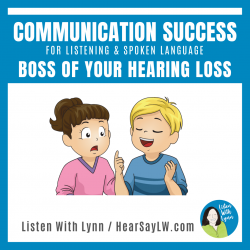
Self-Advocacy Tips for Communication Success
$ 3
Ten self-advocacy tips for communication success for children that are deaf and hard of hearing who use listening and spoken language.
...
Sample Letter to the Teacher - Accommodations - Advocacy in Action
$ 1
Sample letter a student would write to a teacher describing his or her needed accommodations (FM use, seating, speechreading). Sample letter on sharing hearing ability at P07HLU0517.
Me! Lessons for Teaching Self-Awareness and Self-Advocacy
$ 0
This document contains all materials included in the Me! lessons, except for the supplemental PowerPoint presentations. These are listed within each unit and can be downloaded separately from the tabl
...
e below. All 10 units, introductory information, additional resources, and unit quizzes with answers are compiled into a single document. From the University of Oklahoma. 2015.
Comparing Listening Situations
$ 5
This interactive Google Slides activity asks students to evaluate 4 listening situations (presented in pictures and short descriptions) and rate them on a scale according to listening difficulty. Afte
...
r rating the situations, students are tasked with providing an explanation of why each situation is difficult or easy to hear. This would be a great 'stepping off' activity to begin a unit on coping skills or to evaluate how a student perceives different situations and why/how he/she feels about his/her listening abilities.There is very little digital learning activities available for remote learning today. This tool that asks students to rate situations that are difficult or easy to hear encourages introspection about a student's hearing loss. Asking student to explain why the situation is easy or hard to hear encourages them to evaluate their own listening skills and how advocacy can improve even the most difficult situation.Learning Objective:The student will be able to compare listening situations by rating them on a scale from easy to hear to hear. The student will be able to describe why a specific listening situation is difficult or easy to hear, giving support for their answers.
Using an Interpreter - Skills with Identified Common Core Standards (fillable)
$ 275
Progress monitoring sheet specifying student skill areas for interpreter use with the specific common core standard identified for each skill area. Fillable.
Lesson 12 - Evaluating My IEP - Participation
$ 0
Lesson 12 - Evaluating My IEP Participation. This lesson leads students through a process of self-evaluation regarding their participation in their IEP meeting. By Kris English.
Auditory Language & Learning Guide (ALLG)
$ 10
The Auditory Language & Learning Guide is an EXCELLENT informal evaluation tool for listening and language that can be used with students of any age and language ability. The 2 page checklist format e
...
asily allows the teacher to develop IEP goals based on identified student weaknesses in the 4 areas of audition/listening, receptive language, expressive language, and social communication. Skills can be rated as 'targeted', 'emerging', 'mastered' or 'previously assessed' and checked off by date achieved. This assessment tool can be used from year to year allowing instructors and parents to see growth in a students language and learning.
How I Help Student Checklist - Advocacy in Action
$ 125
Student checklist where 19 different positive or negative self-advocacy strategies can be identified. Good foundation to discuss most effective strategies. Includes the How I Help worksheet in which t
...
he student completes 4 sections about: "To help me hear and understand better in the classroom, I will…"
CAVE Checklist - Communication Access in Virtual Education (French)
$ 0
The CAVE Checklist in French is a self-report checklist is intended to be completed students age 9 and above who are deaf or hard of hearing to identify possible communication access issues that may o
...
ccur during virtual education situations. It is recommended that the CAVE be completed in an interview format with the DHH specialist discussing each situation with the student. Students read 10 questions related to accessing communication in online learning situations and rate them from Always Easy to Always Difficult, or Doesn't Happen. A total score can be obtained. Not every situation will apply to every student. Situations indicating appropriate access will receive scores of 4 or 5. Items scoring 1, 2, 3, need to be addressed for appropriate access needs. The 10 questions are followed by a list in which the student identifies what he or she thinks helps most during online learning.


 Cookies