 Your browser is out of date. For best experience switch to latest updated Browser.
 Get Chrome
 Get Edge
 Get Firefox
Ability Levels
Categories
Resource Types
Age/Grade Range
CCSS
Anchor Standard
Speaking & Listening
Language
Reading
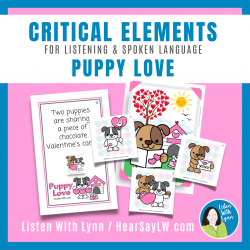
VALENTINE DOGS Puppy Love Listening for Critical Elements Directions Descriptions
$ 7
VALENTINE DOGS - PUPPY LOVE is an engaging following-direction game with critical elements that get kids listening and engaged. Kids love the loveable puppies that challenge auditory working memory, c
...
mory, comprehension, and auditory processing speed. The game uses descriptions that boost critical thinking, executive functioning, and communication skills.VALENTINE PUPPY DOGS is a flexible game where you can play using all the cards, sort out a smaller set, or simplify the directions. It is easy to level up or down the directions to meet a child’s needs and goals.VALENTINE PUPPY DOGS is effective for all children and outstanding for kids who are deaf and hard of hearing and who struggle to recall longer sentences or remember only part of the information that was said. A child’s capacity to listen, remember, and recall impacts their ability to follow complex instructions, understand detailed conversations, and learn new information.INCLUDES:✤ A Huge Resource of 78 playing cards✤ 36 Valentine Puppy Dog picture cards✤ 36 description/direction cards✤ Six Game Mats✤ A set of PRINTABLE game cards✤ A DIGITAL game board✤ Data Collection Sheet✤ A Guide with instructions ✤ Listening and Spoken Language TipsFACE TO FACE - TELETHERAPY - HOME✢ PRINT - One-time easy prep. Print and cut out the Valentine Dog picture and description/direction cards, and print the 6 game mats.✢ DIGITAL - Screenshare the gameboard with your favorite PDF reader such as the free Adobe Acrobat Reader DC. Read the descriptions and the listener marks the dogs using the annotation tools.
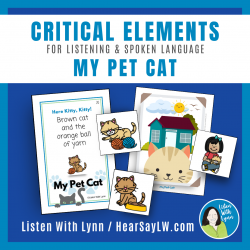
MY PET CAT Listening for Critical Elements Following Directions Descriptions
$ 7
THIS IS IT! A listening and spoken language game that kids ask to play all year long. Kids LOVE the CUTE AND CUDDLY CATS! Players listen to the cat's description and use the details and critical eleme
...
lements to find their cats and take them home. This motivating game is a well-loved way to practice following directions in a playful way. The player with the most pet cats wins the game.YOU CAN TARGET:✤ Listening to critical elements and descriptions, following directions, auditory working memory, auditory processing, auditory comprehension, executive functioning, and communication skills.✤ My Pet Cat is a flexible game that is easy to level up or down to meet a child’s goals. Play using all 54 cards or sort out a small set of game cards to match the player’s needs. ✤ Use the two-page data collection sheet to monitor progress in identifying the critical elements.★ Huge Resource 108 playing cards54 cats + 54 description cards + 6 homes + 2 Digital game boards.INCLUDES:✧ A guide with instructions ✧ 54 cat game cards✧ 54 description cards ➼ A set of PRINTABLE game cards➼ 2 DIGITAL gameboards with 35 cats each✧ Progress monitoring or data collection sheets✧ Listening and Spoken Language TipsIDEAL FOR: Listening & Spoken Language, Deaf & Hard of Hearing, Auditory Processing Disorder, Speech and Language Therapy, School Lessons, Auditory Verbal Sessions, Homeschoolers, TeletherapyFACE TO FACE - TELETHERAPY - HOME✢ PRINT - One-time easy prep. Print and cut out the 54 cats, the description/direction cards, and 6 home mats✢ DIGITAL - Screenshare the gameboard with your favorite PDF reader such as the free Adobe Acrobat Reader DC. Read the descriptions and the listener marks the found cats using the annotation tools.

DINOSAUR HUNT AT SCHOOL Critical Elements Listening Directions
$ 7
Dinosaurs Hunt At School is an amusing following direction game with critical elements that get kids listening and engaged. Kids love the delightful dinosaurs at school that challenge auditory working
...
king memory, comprehension, and auditory processing speed.The game uses descriptions that boost critical thinking, executive functioning, and communication skills. This is a flexible game. You can play using all the cards, sort out a smaller set, or simplify the directions. It is easy to level up or down the directions to meet a child’s needs and goals. Dinosaurs Hunt At Schoolis a listening and spoken language game that kids ask to play all year long.Dinosaurs Hunt At School is effective for children who are deaf and hard of hearing and struggle to recall longer sentences or often remember only part of the information that was said. A child’s capacity to listen, remember, and recall impacts their ability to follow complex instructions, understand detailed conversations, and learn new information.INCLUDES:✧ A guide with instructions ✧ 42 Dinosaurs at School Cards✧ 42 Description Cards✧ 4 Game Mats ➼ A set of PRINTABLE game cards➼ A DIGITAL gameboard for screen sharing✧ Progress monitoring or data collection sheets✧ Listening and Spoken Language TipsIDEAL FOR: Listening and spoken Language, Deaf and hard of Hearing, Auditory Processing Disorder, Speech and Language Therapy, School Lessons, Auditory Verbal Sessions, Homeschoolers, TeletherapyFACE TO FACE - TELETHERAPY - HOME✢ PRINT - One-time easy prep. Print and cut out the description/direction cards, and print the 4 game mats✢ DIGITAL - Screenshare the gameboard with your favorite PDF reader such as the free Adobe Acrobat Reader DC. Read the descriptions and the listener marks the fishing frogs using the annotation tools.COMPANION RESOURCES★★ Additional activities to target critical elementsFroggy Goes Fishing - Critical ElementsMy Pet Cat - Critical ElementsLost Dogs - Critical ElementsSpring Fling - Critical ElementsValentine Snatch - Critical ElementsHoliday Cookie Swap - Critical Elements◈ ◈ ◈ ◈ ◈ ◈ ◈ ◈ ◈ ◈ ◈ ◈ ◈ ◈ ◈ ◈ ◈ ◈ ◈ ◈ ◈ ◈ ◈ ◈ ◈ ◈ ◈ ◈ ◈ ◈ CUSTOMER TIPS:➼ Questions? Email me before purchasing this resource or anytime later.!♥ Sign up HERE for the Listen With Lynn Emails♥ Let’s Connect:InstagramFacebookKeep up your good work. I am blessed to help along the way. Thanks so much!Lynn

Common Children's Phrases - fillable
$ 0
Stimuli that can be used when performing the Functional Listening Evaluation with young children. Partially fillable.

Auditory Rehab - Auditory Training SCRAMBLED STATES Game
$ 6
Play the SCRAMBLED STATES OF AMERICA game with an auditory spin using this Auditory Rehab Game Changer™. This activity is designed for individuals that are deaf and hard of hearing and for use in coch
...
se in cochlear implant rehabilitation for older children, teens, and adults.IDEAL FOR: Deaf & Hard of Hearing, Listening & Spoken Language, Auditory Training, Auditory Rehabilitation, Speech...The SCRAMBLED STATES OF AMERICA Game Changer✤ is played with special directions and rules✤ challenges beginner and intermediate listeners✤ works in closed and bridge listening sets✤ practices identifying words in sets and within connected speech✤ focuses on taking turns, talking while advocating for hearing needs✤ encourages gameplay and practice at home with family and friends✤ practice can lead to communication success✤ is motivating and funGameChangers™➼ result in natural listening practice much different than contrived lists or online or programs.➼ allow for real-time modifications based on the player's auditory skills➼ fosters self-advocacy skills➼ improves communication confidence and successINCLUDES:a pre-game companion that prepares the Listener to play the gamefeatures practice exercises and activities.offers clear directions for therapists, teachers, a listening coach, family members, and friendsincludes listening tips and strategiesfollows an auditory hierarchyNOTE: The amount of practice necessary will vary before a listener is ready to play the game and is dependent upon the listener’s listening skills

Learning To Listen Cards and Progress Monitoring Tool
$ 5
This resource includes a printable set of 30 Learning to Listen* Cards, an Observation Progress Monitoring Tool, and Tips For parents and professionals teaching the Learning To Listen Sounds and Phras
...
rases to a young child who is deaf or hard of hearing utilizing hearing technology such as cochlear implants or hearing aids with the goal of learning to listen and talk. INCLUDES:High-resolution Learning To Listen cards for quality printingObservation Progress Monitoring Tool10 Tips For teaching the Learning To Listen Sounds and PhrasesListening to Listen Sounds - Actions and AdjectivesLearning to Listen Sound - Object AssociationsLearning to Listen Sounds are associated with toys and objects that are commonly part of a baby or young child’s daily routines and activities. Individual families may use a variety of different Learning to Listen sounds, words and phrases depending on their lifestyle and culture. These onomatopoeic sounds contain acoustic properties that are significant in the perception of speech. The Learning to Listen Sounds are easy to hear for most babies wearing hearing technology.Skilled interventionists coach parents and caregivers about auditory skill development while presenting the Learning to Listen toys or activities. Observation data can be collected about the child’s auditory access to aspects of speech like duration, intensity, pitch, and voicing as well as vowel and consonant perception by contrasting toys in strategically chosen groups. This information is critical for optimally setting hearing aids and programming cochlear implants.*Adapted from Simser, 2002, Estabrooks, 2006, Estabrooks & Birkenshaw-Fleming, 1994.

Critical Elements Froggy Goes Fishing Following Directions Descriptive Language
$ 7
Froggy Goes Fishing is an amusing fast-paced following directions game that gets kids listening and engaged. Kids love the delightful frogs and their fishing adventures that challenge auditory working
...
memory and auditory processing speed. The game targets critical elements and descriptive language and helps boost critical thinking, executive functioning, and communication skills. Froggy Goes Fishing is a listening and spoken language game that kids ask to play all year long.
Froggy Goes Fishing is effective for children that are deaf and hard of hearing and who struggle to recall longer sentences and often remember only part of the information that was said. A child’s capacity to listen, remember, and recall impacts their ability to follow complex instructions, understand detailed conversations, and learn new information. Froggy Goes Fishing is a flexible game. You can play using all the cards, sort out a smaller set or simplify the directions. It is easy to level up or down the directions to meet a child’s needs and goals.
INCLUDES:✧ A guide with instructions ✧ 50 Froggy Goes Fishing Cards✧ 50 Description Cards✧ 4 Game Mats ➼ A set of PRINTABLE game cards ➼ 2 DIGITAL gameboards for screen sharing✧ Progress monitoring or data collection sheets✧ Listening and Spoken Language Tips
IDEAL FOR: Listening & Spoken Language, Deaf & Hard of Hearing, Auditory Processing Disorder, Speech and Language Therapy, School Lessons, Auditory Verbal Sessions, Homeschoolers, Teletherapy
FACE TO FACE - TELETHERAPY - HOME✢ PRINT - One-time easy prep. Print and cut out the description/direction cards, and print the 4 game mats✢ DIGITAL - Screenshare the gameboard with your favorite PDF reader such as the free Adobe Acrobat Reader DC. Read the descriptions and the listener marks the fishing frogs using the annotation tools.
◈ ◈ ◈ ◈ ◈ ◈ ◈ ◈ ◈ ◈ ◈ ◈ ◈ ◈ ◈ ◈ ◈ ◈ ◈ ◈ ◈ ◈ ◈ ◈ ◈ ◈ ◈ ◈ ◈ ◈ CUSTOMER TIPS:➼ Questions? Email me before purchasing this resource or anytime later.♥ Sign-up HERE for the Listen With Lynn Emails♥ Let’s Connect:InstagramFacebookKeep up your good work. I am blessed to help along the way. Thanks so much!Lynn

Beyond the Sky’s Limit
$ 299
A collection of comic strips revealing troublesome situations for teens with hearing loss. Includes commentary on how each humorous situation might be resolved.20 more situations and scenarios that m
...
mix humor with compassion in negotiating social communication.More antics and advocacy for teens and tweens with hearing loss.
Activities for Listenings and Learning - ALL (fillable)
$ 295
ALL - Performance Checklist for Development of Complex Listening Skills. Provides a list of Listening, Communication, and Learning Skills with spaces to complete progress. Areas: auditory association,
...
discrimination, memory, closure, humor, etc.

Auditory Memory and Recall Lickety- Split Game
$ 5
Lickety Split is a fast-paced barrier game played swiftly back and forth between two players that target auditory word recall, challenges auditory memory and processing speed.Improvement in the child’
...
d’s ability to listen, remember and recall results in following more complex instructions, understanding detailed conversations, and learning new information.IDEAL FOR: Listening & Spoken Language, Auditory Verbal, Deaf & Hard of Hearing, Speech, ELA, Teletherapy, Distance Learning, Face to Face, Digital, Print...Children that are deaf and hard of hearing with reduced auditory memory abilities may struggle to recall longer sentences, only remember part of what was said and find it hard to recall information they were told in the past and relate it to new learning. Memory boosting strategies and playing games like Lickety Split can boost a child’s spoken language, communication, literacy and academic skills.See my blog post on how I used the Lickety Split Game in teletherapy.Click HEREINCLUDES:➼ 3 sets of colorful and engaging game boards➼ Guidance for children with hearing loss➼ Listening and Spoken Language Tips➼ Terms of Use (see below)Teletherapy, Distance Learning & Face to Face✢ DIGITAL - NO PRINT can be opened and played with your favorite PDF reader app on a tablet. When playing on a computer, open and use a PDF reader such as Adobe Acrobat Reader DC which is free.✢ Use in Easel by TpT for digital resources✢ Print and play face to face or in a small group or classroom

 Cookies