 Your browser is out of date. For best experience switch to latest updated Browser.
 Get Chrome
 Get Edge
 Get Firefox
Ability Levels
Categories
Resource Types
Age/Grade Range
CCSS
Anchor Standard
Speaking & Listening
Language
Reading

Science specific language - Literacy Instruction - Visualization in Science
$ 195
What is ‘visualization’ in science? Scientific research uses the words ’visualization’, ‘image’, ‘visual aid’, and ‘visual literacy’ interchangeably. The term ‘visualization’ is defined as the formati
...
s defined as the formation of mental images and as the process of interpreting information in visual terms. It assists with the explaining, developing, and learning of concepts. These instructional strategies and activities will help you help your students with concepts across the curriculum.

Science specific language - Literacy Instruction - Time Measurement
$ 195
Scientific study is the observation and measurement of change. Use these instructional strategies to teach students the basic scientific units of time (standard and metric). Activities include exami
...
ning root parts such as "chrono," " -ology," reading comprehension and critical thinking, and ideas for extension lessons and student research.

Science specific language - Instructional Strategies - It begins with a good question
$ 195
When you say ‘science’, one thinks of experiments and research. To do research, scientists conduct experiments to answer questions and learn new information. These experiments follow a specific sequen
...
quence of steps called, ‘The Scientific Method’. Use these instructional strategies and activities to help students understand the Scientific Method and how it is applied to science experiments. Activities include determining the difference between a statement and a question, practice writing questions, understanding measurable/ non-measurable information, naming components of an experiment, and conducting an experiment using the Scientific Method.

Listen and Learn Idioms Set One I’m All Ears
$ 4
Listen and Learn Idioms SET ONE is part of a growing series of SAY WHAT? - I'M ALL EARS mini-lessons that are well-loved by kids and adults alike.Listen and Learn Idioms TARGET:Listening and spoken la
...
language, figurative language, vocabulary, word relationships, nuances, and higher-level critical thinking.IDEAL FOR: Listening & Spoken Language, Deaf & Hard of Hearing, Speech, ELA, Teletherapy, Distance Learning, Print…WHAT'S INCLUDED:PDFs of 20 idioms in every packet. Use one or all!Listen and Draw MINI-LESSON sheets with A box to draw and illustrate - THIS IS WHAT I HEARD A box for - SAY WHAT? THIS IS WHAT IT REALLY MEANS!A guide and instructions to makes lessons a piece of cakeData and Progress monitoring sheetsAn answer keyA boatload of book titles are included for further and home learningTerms of Use➯ The PDFs can be printed, screen shared in teletherapy or remote learning platforms, used in face-to-face sessions or lessons, and can be sent home for carryover or homework.SAY WHAT? Here's the trick to make idioms stick! Many commercially available resources provide ILLUSTRATIONS of the literal meaning of the idiom. While this may be entertaining RESEARCH indicates that children who:➼ LISTEN to the idiom➼ VISUALIZE the figurative language➼ DRAW what they literally heard followed by teaching the meaning andusing it in context increases long-term learning.Hearing LossChildren with typical hearing, learn idioms through incidental exposure without having to be taught. Whereas, children who are deaf and hard of hearing often require explicit and direct instruction with higher-level language like idioms. Idioms are challenging for children that process information literally and have a concrete or limited vocabulary.

ASL Weather Activity Worksheets
$ 299
Weather Activity Worksheets ASL combines developmental skills with language arts to help your students succeed. This fun activity will help you assess your student’s understanding of the weather, with
...
th the bonus of sign language. Weather is always a topic that students seem to be interested in, so using that interest to improve skills makes sense. This is an excellent activity for a Preschool, Pre-K, Kindergarten, or First Grade classroom Science Center.
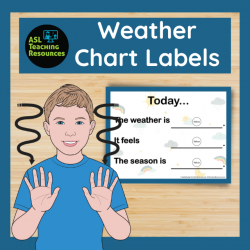
Weather Chart Labels ASL
$ 499
Is something missing from your classroom morning routine? Weather Chart Labels ASL is an excellent way to create a year-long interactive weather bulletin board or weather station. With these labels th
...
at include English, Sign Language signs, and cute graphics, you can meet the needs of visual, auditory, and kinesthetic/tactile learners daily.The possibilities are endless when you add these Weather Chart Labels ASL to your pocket chart, whiteboard, chalkboard, or school doorway. The weather calendar cards will have your young students actively participating in weather discussions and will assist the teacher in guiding focused weather conversations!

Instructional Strategies - In the Mind's Eye-Visual Organizers
$ 195
Nonlinguistic representation to support learning. Teach in ways to help students visually process information. Using graphic organizers, physical models, pictures, and kinesthetic activities. Include
...
s fillable forms and ideas for sensory activities. See BUNDLE at S0XTEA0815.
Science specific language - Instructional Stategy- Composition of matter
$ 195
In examining students’ writing samples, there is often a lack of description related to the aspects of composition. For example, most students are familiar with and describe color, shape, size, and lo
...
location but what something is made of is frequently left out. Using the periodic table and understanding chemical elements can support the awareness of composition. Use of this knowledge can expand descriptive writing. These instructional strategies and activities can be used across the curriculum to reinforce understanding of elements and how they relate to everyday life. Activities include matching elements to every day objects, creating a class periodic table, student research, and how elements are used to produce fireworks.

SCIENCE VOCAB: TREES! #1
$ 0
Domain Specific Science Vocabulary: EVERGREEN AND DECIDUOUS TREES!Want a clever way to increase students' science vocabulary? Use this worksheet at any time during the school year or as the holidays a
...
re approaching when decorating a tree is a tradition for many. This worksheet can be used as a warm-up to the school day, in-between activities, for a group of students, or for individuals.In my many years of working as an educational interpreter, I noticed that it was not unusual for deaf and hard-of-hearing students who were behind their peers struggle with answering questions that began with: "What's your favorite . . .?" Often, they would answer "yes" or not be sure how to answer. The beauty of this type of worksheet is that there is no wrong answer, it is short-yet-effective, and it exposes students to a variety of categories and vocabulary within a specific domain. If time allows, it can open up a discussion on the topic. As a bonus, I added an extra page full of discussion prompts and fun facts. Over time, this type of worksheet will help students learn how to answer this common question that seems easy on the surface, but not for those who do not have the background knowledge and vocabulary necessary to answer it.The thumbnail for this “What’s Your Favorite?” series has a violet purple background - violet for vocabulary! Looking for fast and easy vocabulary building worksheets? Look for the violet thumbnails! Like the "What's Your Favorite...?" worksheet series? Leave me a comment so that I know you would like more!Debbie Love, M.Ed.

Science Specific Language- Instructional Stories-Rainbows
$ 195
Rainbows are fascinating. These worksheets explore the science of rainbows with instructional strategies and activities for introducing light and color along with answering the questions when and wh
...
y rainbows appear. Activities use visuals to introduce new vocabulary, utilize text evidence, reinforce reading comprehension, and critical thinking.

 Cookies