 Your browser is out of date. For best experience switch to latest updated Browser.
 Get Chrome
 Get Edge
 Get Firefox
Ability Levels
Categories
Resource Types
Age/Grade Range
CCSS
Anchor Standard
Speaking & Listening
Language
Reading

The Spirit of Giving
$ 195
This article provides activities to help students recognize that giving to others can be as worthwhile (or more so)as receiving. Worksheets include: "My Gifts" cut and paste for young students; The
...
Giving Board Game with situation game cards that move the player forward for generous acts; "My Giving Checklist" for students to record generous acts; gift certificates to be used as needed; a review of The Giving Tree by Shel Silverstein, suggesting that giving can actually go too far.

Primary/Elementary Listening Situations for Students with Hearing Loss- BUNDLE - Advocacy in Action
$ 395
BUNDLE - Worksheets for primary level instruction on advocating for better hearing during a variety of listening situations. These worksheets guide the student to analyze the listening environment an
...
d make changes for better hearing. Bundle IDs 0492-0496, 0520-0523.
Meeting the Challenge - Keeping Hearing Devices on Young Children - Preschool: 2-5 yrs. old
$ 0
Brochure specifying what makes it challenging to keep hearing aids on 2-5 yrs old, why hearing aids are needed, and strategies to help keep them on, including hearing aid retention devices.

Testing Accommodations - ADA Requirements
$ 0
Informational handout from the US Department of Justice describing ADA requirements for testing accommodations for individuals with disabilities.
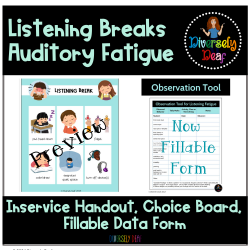
Listening Breaks & Auditory Fatigue
$ 7
Ways this product can be usedInservice HandoutClassroom PosterStudent Choice BoardDiscussion starter with DHH kidsData collection tool Printable and FILLABLEThe visuals representing listener break cho
...
oices are useful for students with hearing differences who need a listening break but are not self-aware or unable to manage the fatigue before it impacts their education.The observation tool is used by staff to collect data and identify factors similar to the process of an FBA. Is there a pattern? Is it occasional, frequent, or chronic? What precedes the fatigue? Hungry? Good night sleep? If listener fatigue is a possibility discuss your findings with the Teacher of the deaf.
Parts of the Ear Game
$ 5
This is a fun digital learning activity for a student to review the 3 parts of the ear. The learner identifies the function of each part, what is in each part and uses a diagram to identify parts of t
...
he ear.There are very few digital learning activities available today. Advocacy practice for students with hearing loss includes learning about hearing. As students begin to learn how they ear, identifying the 3 parts of the ear is a first step. They need lots of practice labeling different parts of the ear and identifying how they help with hearing. Learning Objective:1. The student will be able to identify functions of the 3 parts of the ear. 2. Given a diagram, the student will label the part of the ear.
Lesson 12 - Evaluating My IEP - Participation
$ 0
Lesson 12 - Evaluating My IEP Participation. This lesson leads students through a process of self-evaluation regarding their participation in their IEP meeting. By Kris English.
Comparing Listening Situations
$ 5
This interactive Google Slides activity asks students to evaluate 4 listening situations (presented in pictures and short descriptions) and rate them on a scale according to listening difficulty. Afte
...
r rating the situations, students are tasked with providing an explanation of why each situation is difficult or easy to hear. This would be a great 'stepping off' activity to begin a unit on coping skills or to evaluate how a student perceives different situations and why/how he/she feels about his/her listening abilities.There is very little digital learning activities available for remote learning today. This tool that asks students to rate situations that are difficult or easy to hear encourages introspection about a student's hearing loss. Asking student to explain why the situation is easy or hard to hear encourages them to evaluate their own listening skills and how advocacy can improve even the most difficult situation.Learning Objective:The student will be able to compare listening situations by rating them on a scale from easy to hear to hear. The student will be able to describe why a specific listening situation is difficult or easy to hear, giving support for their answers.
Self-Advocacy Tips for Communication Success
$ 3
Ten self-advocacy tips for communication success for children that are deaf and hard of hearing who use listening and spoken language.
...

Which Assistive Devices Will be Useful to Me - Advocacy in Action
$ 1
Worksheet in which students list a) Devices I will use in the future, b) Devices I may use in the future, c) Devices I will not use. To be used after discussion of different types of assistive devices
...
.

 Cookies