 Your browser is out of date. For best experience switch to latest updated Browser.
 Get Chrome
 Get Edge
 Get Firefox
Ability Levels
Categories
Resource Types
Age/Grade Range
CCSS
Anchor Standard
Speaking & Listening
Language
Reading

Early Morphological Development
$ 0
Morphology is the aspect of language concerned with the rules governing change in word meaning. Morphological development is analyzed by computing a child’s Mean Length of Utterance (MLU). This handou
...
out provides information about acquisition of grammatical morphemes

Unilateral - Relationship of Hearing Loss to Listening and Learning
$ 0
Handout with information on possible impact on understanding language, speECH-, social, and need for educational accommodations and services. For unilateral hearing loss.

Article: Important ADA Policy Guidance on Effective Communication
$ 0
This article provides background information on the requirements of IDEA, Section 504, and Title II of the ADA that require supports and services for eligible students with hearing loss. It describes
...
the meaning of effective communication under Title II of the ADA and implications for schools. By Cheryl DeConde Johnson.
Brochure - Hearing Loss in One Ear - Unilateral Hearing Loss
$ 0
Printable brochure for families of infants and toddlers diagnosed with unilateral hearing loss. Includes prevalence, impact, and things parents can do.
Article: The Influence of Hearing Aid Uses on Outcomes of Children with Mild Hearing Loss
$ 0
This study examined the effects of consistent hearing aid use on outcomes in children with mild hearing loss. The results provided evidence that children's language development benefits from consisten
...
t hearing aid use.

Why Involve the Teacher of the Deaf/Hard of Hearing
$ 0
Why Involve the Teacher of the Deaf/Hard of Hearing on the Assessment Team and the IEP? This informational handout is designed to share with school teams, classroom teachers, and parents. I provides i
...
nformation raising awareness of the unique access and communication needs of students and the role of the teacher of the deaf/hard of hearing.

71-90+dB - Relationship of Hearing Loss to Listening and Learning
$ 0
Handout with information on possible impact on understanding language, speECH-, social, and need for educational accommodations and services. For 71-90+dB or severe-profound hearing loss.
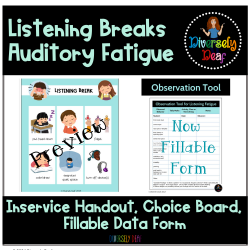
Listening Breaks & Auditory Fatigue
$ 7
Ways this product can be usedInservice HandoutClassroom PosterStudent Choice BoardDiscussion starter with DHH kidsData collection tool Printable and FILLABLEThe visuals representing listener break cho
...
oices are useful for students with hearing differences who need a listening break but are not self-aware or unable to manage the fatigue before it impacts their education.The observation tool is used by staff to collect data and identify factors similar to the process of an FBA. Is there a pattern? Is it occasional, frequent, or chronic? What precedes the fatigue? Hungry? Good night sleep? If listener fatigue is a possibility discuss your findings with the Teacher of the deaf.
*FREEBIE* Teacher/Team Survey for Virtual Teachers of the Deaf and Hard-of-Hearing
$ 1
This resource contains survey questions that for virtual Teachers of the Deaf and Hard-of-Hearing to share with their students' team members. Teachers can add these questions to a virtual form or an e
...
mail in order to obtain feedback about virtual DHH services.
Age 12-19 - Reconciling Feelings of Fitting In - Building Self-Confidence & Resilience
$ 250
For ages 12-19 years: This information addresses feelings of fitting in, problem-solving, social isolation, identity, importance of role models, positive outlook, and dealing with challenges due to he
...
aring loss. The purpose of this book is to raise awareness for the reasons why hearing device rejection happens and specific instruction to occur at different ages to build student resilience and self-confidence, thereby increasing the likelihood that they will not reject using their hearing technology. Specific teaching activities and recommendations for instructional materials to develop identified skills have been included in this Guide.

 Cookies