 Your browser is out of date. For best experience switch to latest updated Browser.
 Get Chrome
 Get Edge
 Get Firefox
Ability Levels
Categories
Resource Types
Age/Grade Range
CCSS
Anchor Standard
Speaking & Listening
Language
Reading
COMPASS Test
$ 0
Dave
Syndrey created a functional test of fine auditory discrimination and has
allowed Supporting Success to make it available. COMPASS test recording form,
test interpretation guide, and
...
COMPASS cards for print.

IEP/504 Checklist: Accommodations and Modifications for Students who are Deaf and Hard of Hearing
$ 0
One-page checklist for school teams to use when considering school accommodations for students with hearing loss. From Educational Audiology Handbook.
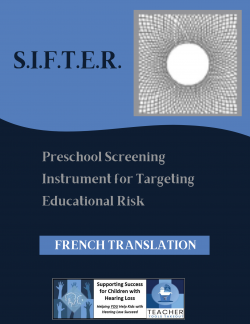
Preschool SIFTER - Screening Instrument For Targeting Educational Risk - French Translation
$ 0
French Translation - The Preschool Screening Instrument For Targeting Educational Risk (SIFTER) was created as a tool to screen the functional performance of students with hearing loss in preschool th
...
rough kindergarten (ages 3-6). It includes a scoring grid to identify areas of concern.

SIFTER - Screening Instrument For Targeting Educational Risk - Turkish Translation
$ 0
Turkish Translation -The Screening Instrument For Targeting Educational Risk (SIFTER) was created as a tool to screen the functional performance of students with hearing loss in secondary school (ages
...
12-18). It includes a scoring grid to identify areas of concern.

Secondary SIFTER - Screening Instrument For Targeting Educational Risk - Danish Translation
$ 0
Danish Translation - The Secondary Screening Instrument For Targeting Educational Risk (SIFTER) was created as a tool to screen the functional performance of students with hearing loss in secondary sc
...
hool (ages 12-18). It includes a scoring grid to identify areas of concern.

Article: Literature Review and Analysis of Itinerant Teachers of the Hearing Impaired Located in the Midwest: Service Delivery Model in Education
$ 0
The role and responsibilities of an itinerant teacher of students who are deaf or hard of hearing were investigated to create a database of information about the effective traits of successful itinera
...
nt teachers. 2008.

Supporting Students who are Deaf and Hard of Hearing: Recommended Roles of Educational Audiologists and Teachers of the Deaf and Hard of Hearing
$ 0
This information compares the role of educational audiologists and teachers of the deaf/hard of hearing in providing services and supports to students with hearing loss. From Educational Audiology Ass
...
ociation.
Auditory Language & Learning Guide (ALLG)
$ 10
The Auditory Language & Learning Guide is an EXCELLENT informal evaluation tool for listening and language that can be used with students of any age and language ability. The 2 page checklist format e
...
asily allows the teacher to develop IEP goals based on identified student weaknesses in the 4 areas of audition/listening, receptive language, expressive language, and social communication. Skills can be rated as 'targeted', 'emerging', 'mastered' or 'previously assessed' and checked off by date achieved. This assessment tool can be used from year to year allowing instructors and parents to see growth in a students language and learning.

Secondary SIFTER - Screening Instrument For Targeting Educational Risk - Portuguese Translation
$ 0
Portuguese Translation -The Secondary Screening Instrument For Targeting Educational Risk (SIFTER) was created as a tool to screen the functional performance of students with hearing loss in secondary
...
school (ages 12-18). It includes a scoring grid to identify areas of concern.
Communication Competence Areas for D/HH Students
$ 4
Use this chart to help visualize the communication areas that need to be addressed and/or supported when working with students with hearing differences.
...

 Cookies